Outline
Quark Models of Omega Mesons

 where each repeated cycle
  is composed of the following quarks.
The foregoing quark models completely specify the quantum numbers of omega mesons. The charge, angular momentum, baryon-number, lepton-number and strangeness are all correct. These models also produce accurate calculated values for the lifetime, width and mass. Results that fall outside of experimental uncertainty are noted with an X in all tables. There are just a handful of these errors from among hundreds of particles.
Omega Meson Cores

Some highly excited states contain so many quarks that it may be difficult to see how the models work. So to view the underlying pattern, we ignore most of the quark/anti-quark pairs. The  pairs are needed for stability. But these field quarks obscure the minimum number of quarks required to identify a particle and account for its mass. So we remove them and the remaining core quarks are shown in the table below.
Fixing attention on the core shows more clearly how excited omega mesons are built-up over blocks of the same baryonic quarks. The mass depends on  not
not  . So
. So  is unchanged by any variation in the field of pairs. A particle’s rest mass is completely determined by its core quarks.
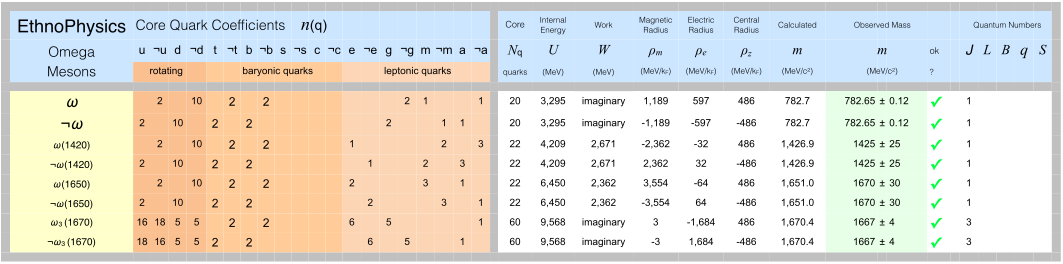
Experimentally observed values are taken from this reference .
Omega Meson Calculations
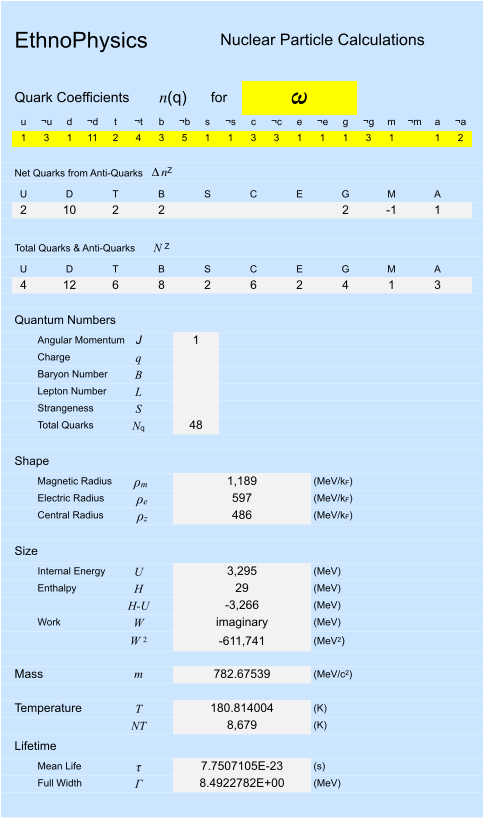
Here is a spreadsheet that shows a step-by-step calculation of omega meson characteristics. For more detail about cell contents and formulae, click the download link at the bottom of the sheet. Then you can enter other quark-coefficients in the yellow cells to assess different particle models.