
Outline
A Seed Model of the Muon
EthnoPhysics describes a muon by starting with a prototypical chain of events written as  Each repeated cycle
  is a bundle of 40 Anaxagorean sensations. To be exact, the sensations are eight right-side and twelve left-side lateral feelings; two burning, two freezing, two warm and two cool thermal perceptions; four green, four red and four white visual sensations. Each of these Anaxagorean sensations may be objectified to define a seed. And so to make a seed aggregate model of the muon we express as a bundle of seeds

A Quark Model of the Muon
Quarks are defined by pairs of seeds. So the seed-aggregate model of the muon is further developed by associating seeds in pairs to form the following quarks
 | + |  | → |  |
 | + |  | → |  |
 | + | | → |  |
 | + | | → |  |
 | + | | → |  |
 | + | | → |  |
 | + | | → |  |
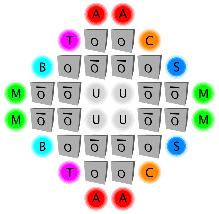
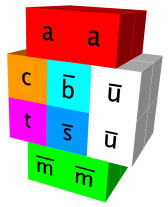
A muon can then be represented by a bundle of twenty quarks. Here is a symbolic way of expressing the arrangement, along with an iconic image for the model.

Using these quarks, the mass of the muon, written as  is calculated to have exactly the same value as observed experimentally . This is because
  presents an essential fact about the human environment. So it has been meticulously integrated into the EthnoPhysics description of human experience. Adjustable parameters like quark energies have been methodically selected to obtain accuracy.
The Core of a Muon

Quark coefficients are all integer multiples of two in the foregoing quark-model. And so the muon’s iconic image is drawn in two parts with a back row of quarks that are the same as the quarks in front. But we cannot have two identical quarks in the same bundle and still satisfy Pauli’s exclusion principle. So the model is developed further with an additional requirement that quarks on the front-side are out of phase with quarks from the back. This is noted by marking the phase of a quark using a subscript like  or
or 
Thus the front-side and back-side of the model represent different phase components of the muon. And since quarks are matched one-to-one between sides, we say that these components have phase symmetry with each other. This satisfies the definition for being in a ground-state and so the updated arrangement is called a ground-state model of the muon. Phase-symmetry is symbolized using  to note phase-components. Mathematically, the muon is represented by these sets of quarks



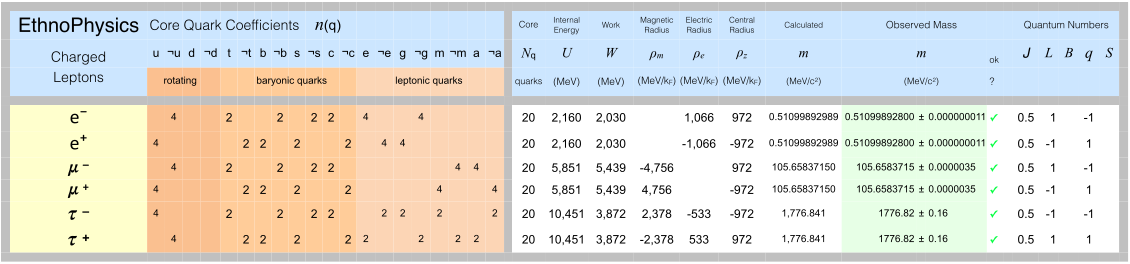
This definition explicitly shows that all quarks in the muon are distinct. They can each be distinguished by their quark-type, their phase, or by association with other quarks in unique nested sets. Next here are quark-coefficients for a muon core. Particle properties like the mass and charge are completely determined by these core quarks.
Muonic Charge
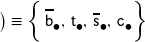
Here is another way of parsing the quarks in a muon. Recall that we have discussed a particle noted by – that is called the mesonic charge. Its lepton and baryon numbers are both zero. And it has a charge quantum number of  –
– It was defined by these quarks
–
 –
–
 –
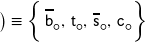
–
Also, please remember the muonic roton written as  This leptonic field-quantum has an angular-momentum number of
  and a lepton number of
  It was defined by



An inspection of the quarks in – and  shows that they can be matched one-to-one with quarks in the definitive set
  So muons can be concisely described as the union of a charged core –, with a rotating magnetic-field
  We write

 {–
{– }
}
Muon Lifetime
The temperature of a muon is found from the average temperature of its component quarks to be 142.9307574 (K). This implies a calculated mean life of  (s), which is within experimental uncertainty of the observed1S. Navas et al.(Particle Data Group), Phys. Rev. D110, 030001 (2024) and 2025 update value.
Muon Calculations
Here is a spreadsheet that shows a step-by-step calculation of muon characteristics. For more detail about cell contents and formulae, click the download link at the bottom of the sheet. Then you can enter other quark-coefficients in the yellow cells to assess different particle models.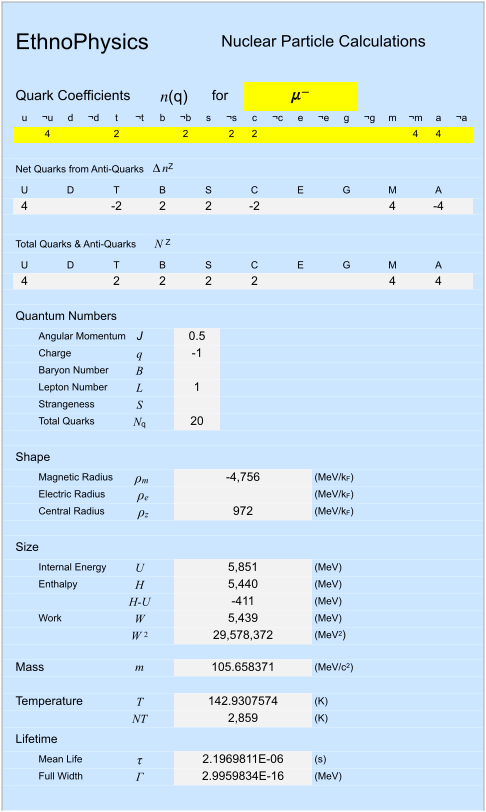
| 1 | S. Navas et al.(Particle Data Group), Phys. Rev. D110, 030001 (2024) and 2025 update |
|---|