
Outline
Here is a sketch for making some experimentally testable predictions.
Magnetic Susceptibility

The magnetic susceptibility is an indication of how much a particle is influenced by surrounding magnetic fields. It is a dimensionless constant noted by  . In an extension of the assumption of conjugate symmetry we presume that ordinary-quarks and anti-quarks have the same susceptibilities. Then the quark index
  can specify values of as shown in the adjacent table. These numbers are obtained by analyzing laboratory observations of nuclear particles.
| Magnetic Susceptibility | ||
|---|---|---|
| 𝜁 | Z | ![\chi_{m} \rule[-6px]{0.1pt}{0.1pt}](https://www.ethnophysics.org/wp-content/ql-cache/quicklatex.com-cf9a02fca7ce804b41d10ec676f2cbcb_l3.png "Rendered by QuickLaTeX.com") |
| 1 | U | 2.449148 |
| 2 | D | 0.535786 |
| 3 | E | 2.093534 |
| 4 | G | 1.767340 |
| 5 | M | -0.096763 |
| 6 | A | 0.229434 |
| 7 | T | 1.220846 |
| 8 | B | 0.360208 |
| 9 | S | -1.953003 |
| 10 | C | 2.433428 |

Sensory interpretation: The magnetic-susceptibility describes some implied mixing between different classes of sensation. Remember that magnetic fields and muonic quarks are associated with redness. So ultimately, they are objectified from the sight of blood. And recall Ernst Mach’s remark that the perception of a sensation is connected to “dispositions of mind, feelings, and volitions”. So magnetic-susceptibility may be viewed as a mathematical description of how the sight of blood affects other perceptions. This is especially relevant for distinguishing between safe and dangerous conditions.
Induced Charge
The safety of a thermal sensation is represented by its baryonic quarks, and subsequently its charge. But magnetic-susceptibility is a more generalized concept, so we introduce a related quantity called the induced charge which is noted by  Sensory imbalances are mathematically described by
  And any imbalances are broadly associated with risk. So we account for the relationship between seeing blood and danger by defining the induced charge as

The number  is a constant called the elementary charge. It is measured in Coulombs and abbreviated by (C).
Magnetic Moments
Consider some particle P characterized by its period  . In a Cartesian descriptive framework P is rotating. Then the current
  due to the rotation of the induced charge
  is given by

This current is measured in Coulombs per second, or Amperes, and abbreviated by (A). The magnetic moment due to the rotation of any  -type quarks may be defined from the current as

where  is P’s cross-sectional area and
  is P’s central axis. The norm of a moment is written without an overline as
  . By this definition the magnetic-moment is given by the product of a current and an area, so the measurement units used for
  are abbreviated as (A∙m2). The magnetic-moment of the whole particle P is defined by a sum over quark moments

All quark moments are aligned with the central-axis, so by these definitions

where  is the orbital radius of P. This radius is given by
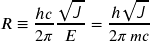
where  is P’s total angular-momentum quantum number, and
  is P’s mechanical energy. We assume that P is stationary or in slow motion so that its energy can be written as
  where
where  is P’s rest mass. We may also write the cross-sectional area in terms of these quantities as
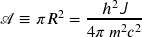
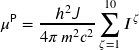
The foregoing equations may all be combined to state the magnetic-moment of P as
We can also use Planck’s postulate to express the current as
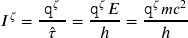
Then the magnetic-moment of P may be written as
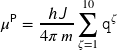
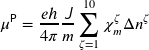
Recall that the induced-charge is related to the magnetic-susceptibility by the definition  where
where  notes P’s quark coefficients and is a constant called the elementary charge. Then finally we can express the magnetic-moment in terms of quark-coefficients as
Experimental Comparison
The forgoing expression summarizes all thirteen known nuclear magnetic-moments to within experimental error.1J. Beringer et al. (Particle Data Group), The Review of Particle Physics, Phys. Rev. D86, 010001, 2012., 2J. DiSciacca et al. (ATRAP Collaboration), One-Particle Measurement of the Antiproton Magnetic Moment Phys. Rev. Lett. 110, 130801, 2013., 3G. Lopez Castro, A. Mariano, Determination of the Delta++ Magnetic Dipole Moment arXiv:nucl-th/0006031, 2001. The representation uses ten adjustable parameters, i.e. the magnetic-susceptibilities of the ten different types of thermodynamic quarks.
Here is a graph comparing calculated versus observed magnetic-moments for baryons. The electron and muon are far off the scale of this image, but the moments of both particles are within experimental error as well.


Using 10 parameters to represent 13 observations is a lackluster feat of data compression. But the quark-coefficients of other nuclear particles are already known from mass and lifetime experiments. So this pattern might be used to make predictions for particles that have not yet had their magnetic-moments measured.
| 1 | J. Beringer et al. (Particle Data Group), The Review of Particle Physics, Phys. Rev. D86, 010001, 2012. |
|---|---|
| 2 | J. DiSciacca et al. (ATRAP Collaboration), One-Particle Measurement of the Antiproton Magnetic Moment Phys. Rev. Lett. 110, 130801, 2013. |
| 3 | G. Lopez Castro, A. Mariano, Determination of the Delta++ Magnetic Dipole Moment arXiv:nucl-th/0006031, 2001. |